← All boards
Educational › Effects Built From Scratch

Stereo Phaser Built From Allpass_2

Plays on the mobile app
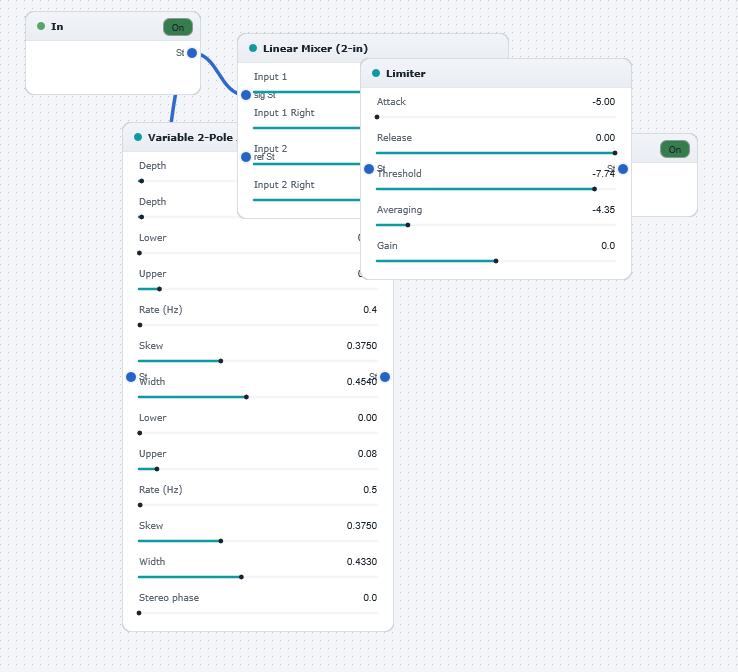
The Stereo Phaser Built From Allpass_2 board in the WaveWarp DrawingBoard
Stereo Phaser Built From Allpass_2 — the board as it opens in the WaveWarp DrawingBoard.

What it does

Phaser built from variable all-pass

A less general (but more efficient) implementation of the phaser algorithm illustrated in the "Phaser Built from Scratch" DrawingBoard. Here the time-varying allpass filter is self-contained i.e. the parameters for controlling the sweeping notch are built in to the effect and need not be supplied as external control inputs. (There is a slight loss of generaliy since there is not complete freeedom in choosing the notch sweep characteristics: only the exponential sweep is available. If you need complete freedom, use the "Phaser Built from Scratch" DrawingBoard).

The heart of this phaser algorithm is the Variable 2-pole allpass filter whose frequency response has a flat magnitude spectrum but a nonlinear phase response. When the allpass filter is connected in parallel with the original dry signal (via the Linear Mixer), the net effect is a notch filter. The key to achieving the classical "phaser" effect is to vary the allpass filter coefficients in time, such that the notch filter varies in time. The Variable 2-pole allpass block is designed for this purpose. It contains parameters for adjusting the exponential sweep of the the instantaneous centre frequency and bandwidth of the of the notch.

The limiter ensures that the output doesn't cause digital clipping arising from constructive interference of the dry signal with the notched signal.

Try changing all parameter settings of all components to achieve a wide range of interesting feedback phasing effects. Also, try replacing the "Variable 2-pole allpass" block with a "Variable feedback allpass" block in order to build an efficient feedback phaser.

Effects used

5 blocks 5 connections
In WaveWarp, 1998

How the original documented it

Phaser built from variable all-pass A less general (but more efficient) implementation of the phaser algorithm illustrated in the "Phaser Built from Scratch" DrawingBoard. Here the time-varying allpass filter is self-contained i.e. the parameters for controlling the sweeping notch are built in to the effect and need not be supplied as external control inputs. (There is a slight loss of generaliy since there is not complete freeedom in choosing the notch sweep characteristics: only the exponential sweep is available. If you need complete freedom, use the "Phaser Built from Scratch" DrawingBoard). The heart of this phaser algorithm is the Variable 2-pole allpass filter whose frequency response has a flat magnitude spectrum but a nonlinear phase response. When the allpass filter is connected in parallel with the original dry signal (via the Linear Mixer), the net effect is a notch filter. The key to achieving the classical "phaser" effect is to vary the allpass filter coefficients in time, such that the notch filter varies in time. The Variable 2-pole allpass block is designed for this purpose. It contains parameters for adjusting the exponential sweep of the the instantaneous centre frequency and bandwidth of the of the notch. The limiter ensures that the output doesn't cause digital clipping arising from constructive interference of the dry signal with the notched signal. Try changing all parameter settings of all components to achieve a wide range of interesting feedback phasing effects. Also, try replacing the "Variable 2-pole allpass" block with a "Variable feedback allpass" block in order to build an efficient feedback phaser.

Components used (1998)

Variable 2-pole allpassInput WAV fileOutput Stereo WAVE DriverLinear MixerAudio Limiter