The story of an audio workbench

Draw sound.
Hear it come alive.

WaveWarp is a live drawing board for audio: drag blocks onto a canvas, wire them together, and the sound flows through your chain in real time — one sample at a time. The same idea, from a 1998 classic to a modern, cross-platform revival.

One idea that never changed

Every block does one thing to sound — read a sound card, apply an effect, mix, measure, record. The cable between two blocks is the audio flowing from one to the next. You literally draw your own signal path, and you hear it run in real time as you build it.

Under the hood, WaveWarp processes one sample-frame at a time. That is what makes true, sample-accurate feedback loops possible — and it has been the beating heart of WaveWarp since day one.

Audio cable Control signal Clock master Sample-per-sample Realtime
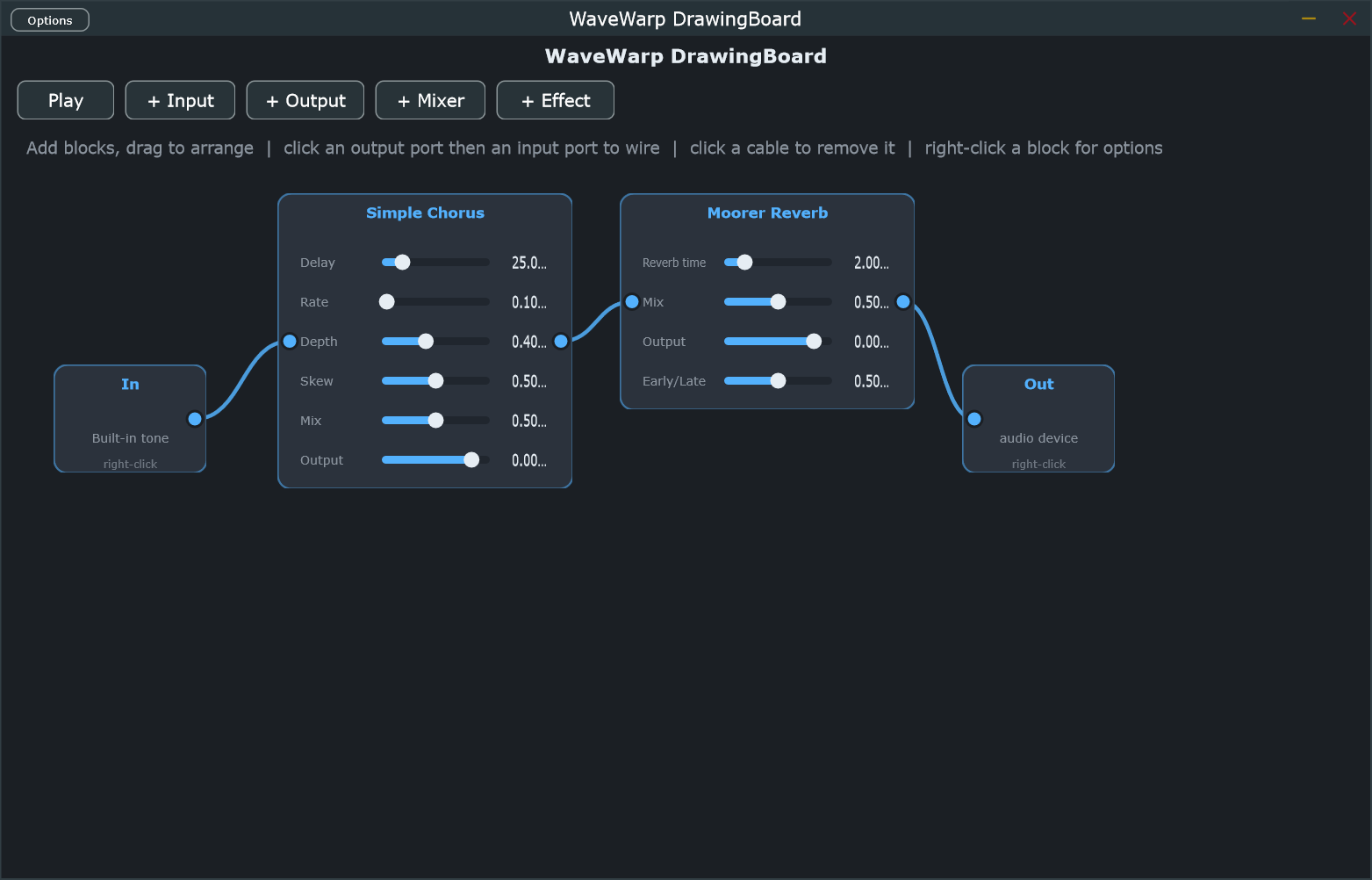
A modern WaveWarp board: an input feeding a chorus and reverb into an output
A WaveWarp board today. A tone source runs into a chorus, into a reverb, out to your speakers — live, editable while it plays.
1998 → today

The journey

WaveWarp began as a commercial Windows product from Sounds Logical, went quiet for two decades, and came back rebuilt from the ground up.

1998 – 2002 · Sounds Logical

The original WaveWarp

A Windows workbench and a DirectX effect host in one. It shipped with a Component Library of effects, a live message window, transport controls and parameter windows — and it earned an Electronic Musician 2001 Editors' Choice.

The workbench

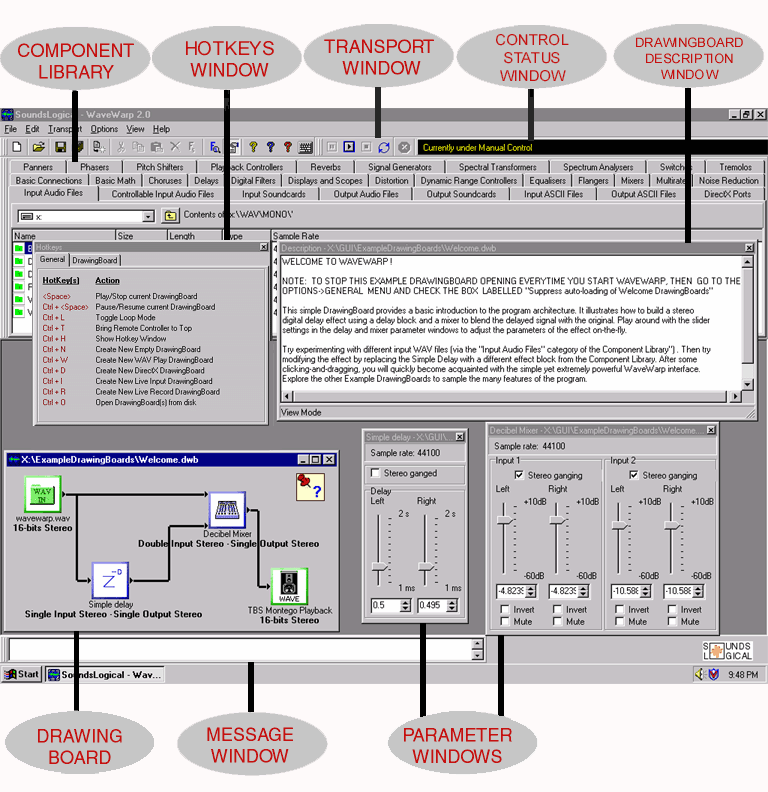
Everything on one screen

The Component Library on the left, a hotkeys window, a transport window, the drawing board, and floating parameter windows for every block. It looked like Windows 98 — because it was.

A real board, 1998-style

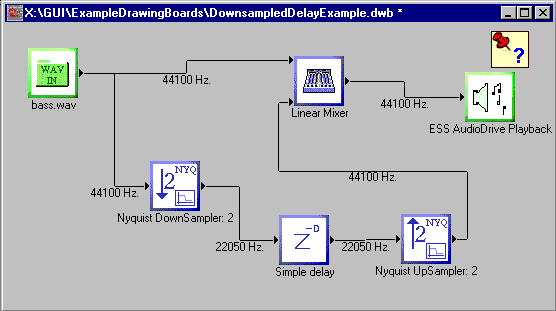
The same graph, 27 years ago

A WAV input fanned into a down-sampler, a delay and an up-sampler, then merged and played out — mixing sample rates on one board. Different chrome, identical concept to the board at the top of this page.

2002 – 2025

Quiet years

Sounds Logical wound down and WaveWarp went dormant. The source survived, the licensed third-party pieces did not travel — but the core idea kept its pull.

2026 · The revival

Rebuilt, modern, and yours everywhere

A clean C++17 / JUCE engine drives one core into two front-ends: the cross-platform DrawingBoard desktop app and a mobile player on Android. Your boards live in your account in the cloud, so the same board plays on your phone.

Then & now

Same soul, new body

1998
Original WaveWarp board
Windows-only. A boxed DirectX host and standalone app, one machine, floating parameter windows.
2026
Modern WaveWarp board
Cross-platform & cloud. Desktop + phone, themed UI, boards synced to your account, effects inline on the block.
The 2026 build

What the revival adds

Everything the original could do, plus the things a modern machine — and a phone — make possible.

Sample-accurate engine

The per-sample core is intact, so feedback loops behave exactly right — no block-processing shortcuts.

Multi-device & multi-rate

Record from one interface and play out of another — different clocks and sample rates on one board.

Up to 16 channels

Cables carry a bus, not just one channel. Split, process and merge from mono to surround.

Convolution reverb

Fold your signal through a real room's impulse response, stored in your own cloud IR library.

Subgraphs

Bundle a busy patch into one tidy block, dive in to edit, pop back out — wiring intact.

Cloud boards & mobile

Boards live in your account and autosave. Draw on the desktop, then play the same board on your phone.

Sound you can draw, and hear in real time — processed one sample at a time — now open where the original was closed, on every device you own.
Try it

Pick up where WaveWarp left off

Explore the mobile player that brings the boards you draw straight to your phone.