What it does
Audio noise gate.
The noise gate is the extreme case of the expander. It eliminates all signals below the user-defined the threshold. It works by measuring the average signal power and applying a logarithmic automatic gain control to the signal, based on the average measurement.
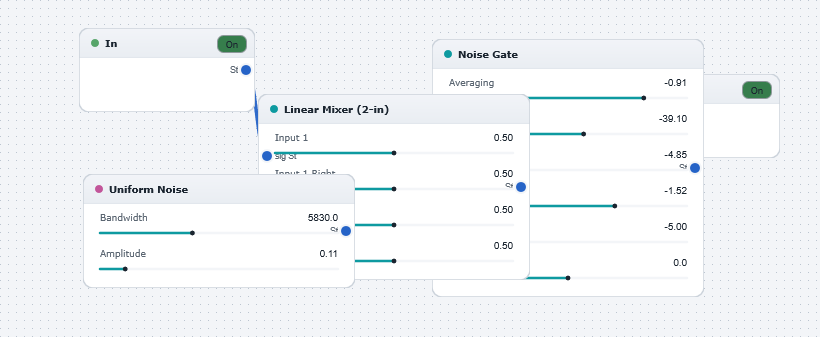
In this illustrative example, the drums are mixed with a low amplitude noise, and passed through the noise gate. The effect of the noise gate is to eliminate the usually low-volume contributions (e.g. the noise and also the trailing cymbal echos) . (Compare with the original sound by momentarily connecting the output of the mixer directly to the output device.)