← All boards
Signal Visualisation

Visualisation Of Chaos Example1

Plays on the mobile app
The Visualisation Of Chaos Example1 board in the WaveWarp DrawingBoard
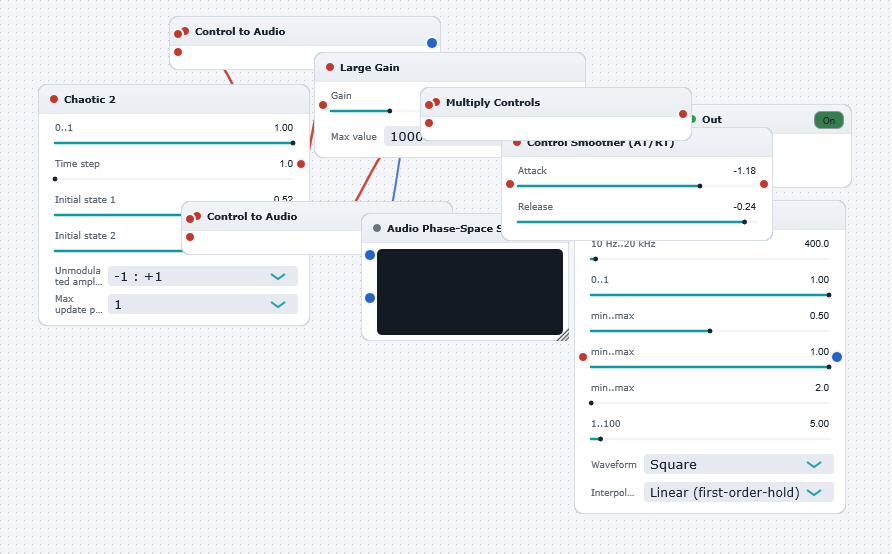
Visualisation Of Chaos Example1 — the board as it opens in the WaveWarp DrawingBoard.

What it does

Visualisation of Chaos Example 1

Illustrates the use of the Audio Phase-Space Scope for real-time phase-space plotting of the two output states from the Henon Strange Attractor (the basis of the Chaotic Control Generator 2). Play the DrawingBoard and observe the real-time evolution of this classic phase-space trajectory.

The "strange attractor" is named so because the trajectory remains forever bounded, as evident in the scope, though it never repeats itself exactly. In other words, the states are "attracted" towards the bounded regime. They repeatedly cycle around without ever precisely re-tracing their tracks.

This can lead to interesting music connotations, since, by definition, music consists of almost periodic sequences of almost-periodic sounds!

In this example, the outputs of the strange attractor are simply multiplied together, amplified, smoothed, then fed into the Controllable Combo Oscillator to control its frequency. The result is an "alien hum" which is not completely periodic.

Experiment with all settings of all components to and enjoy the chaos in the process.

[Refs: (1) "Introduction to Applied Mathematics", Gilbert Strang, Wellesley-Cambridge Press, 1986. p 504-505. (2) "Chaos: making a new science", James Gleick, Penguin Books, 1987, p 149-151.]

one audio signal versus another. In this example, a chaotic wave (produced by the Controllable Combo Oscillator driven by the Chaotic Control Generator 1) is passed through a Moorer Comb filter (a key element of IIR-based reverbs) and plotted against a delayed version of itself.The interesting thing to note is how the shape of the plot (in the Audio Phase-Space Scope) has a regular pattern but yet never repeats itself. This is a hallmark of chaotic systems.

Try increasing the gains of the Moorer Comb filter. Interesting musical sounds will emerge (due to the reverberant effect of the comb filter).

Effects used

9 blocks 10 connections
In WaveWarp, 1998

How the original documented it

Visualisation of Chaos Example 1 Illustrates the use of the Audio Phase-Space Scope for real-time phase-space plotting of the two output states from the Henon Strange Attractor (the basis of the Chaotic Control Generator 2). Play the DrawingBoard and observe the real-time evolution of this classic phase-space trajectory. The "strange attractor" is named so because the trajectory remains forever bounded, as evident in the scope, though it never repeats itself exactly. In other words, the states are "attracted" towards the bounded regime. They repeatedly cycle around without ever precisely re-tracing their tracks. This can lead to interesting music connotations, since, by definition, music consists of almost periodic sequences of almost-periodic sounds! In this example, the outputs of the strange attractor are simply multiplied together, amplified, smoothed, then fed into the Controllable Combo Oscillator to control its frequency. The result is an "alien hum" which is not completely periodic. Experiment with all settings of all components to and enjoy the chaos in the process. [Refs: (1) "Introduction to Applied Mathematics", Gilbert Strang, Wellesley-Cambridge Press, 1986. p 504-505. (2) "Chaos: making a new science", James Gleick, Penguin Books, 1987, p 149-151.] one audio signal versus another. In this example, a chaotic wave (produced by the Controllable Combo Oscillator driven by the Chaotic Control Generator 1) is passed through a Moorer Comb filter (a key element of IIR-based reverbs) and plotted against a delayed version of itself.The interesting thing to note is how the shape of the plot (in the Audio Phase-Space Scope) has a regular pattern but yet never repeats itself. This is a hallmark of chaotic systems. Try increasing the gains of the Moorer Comb filter. Interesting musical sounds will emerge (due to the reverberant effect of the comb filter).

Components used (1998)

Output Single-Mono WAVE DriverChaotic Control Generator 2 (A)Control to AudioControl to AudioControllable Combo Oscillator (F)Large Control GainAudio Phase-Space ScopeControl Smoother with AT-RTMultiply Controls