What it does
Stereo bass boost with delay, widened from a mono input.
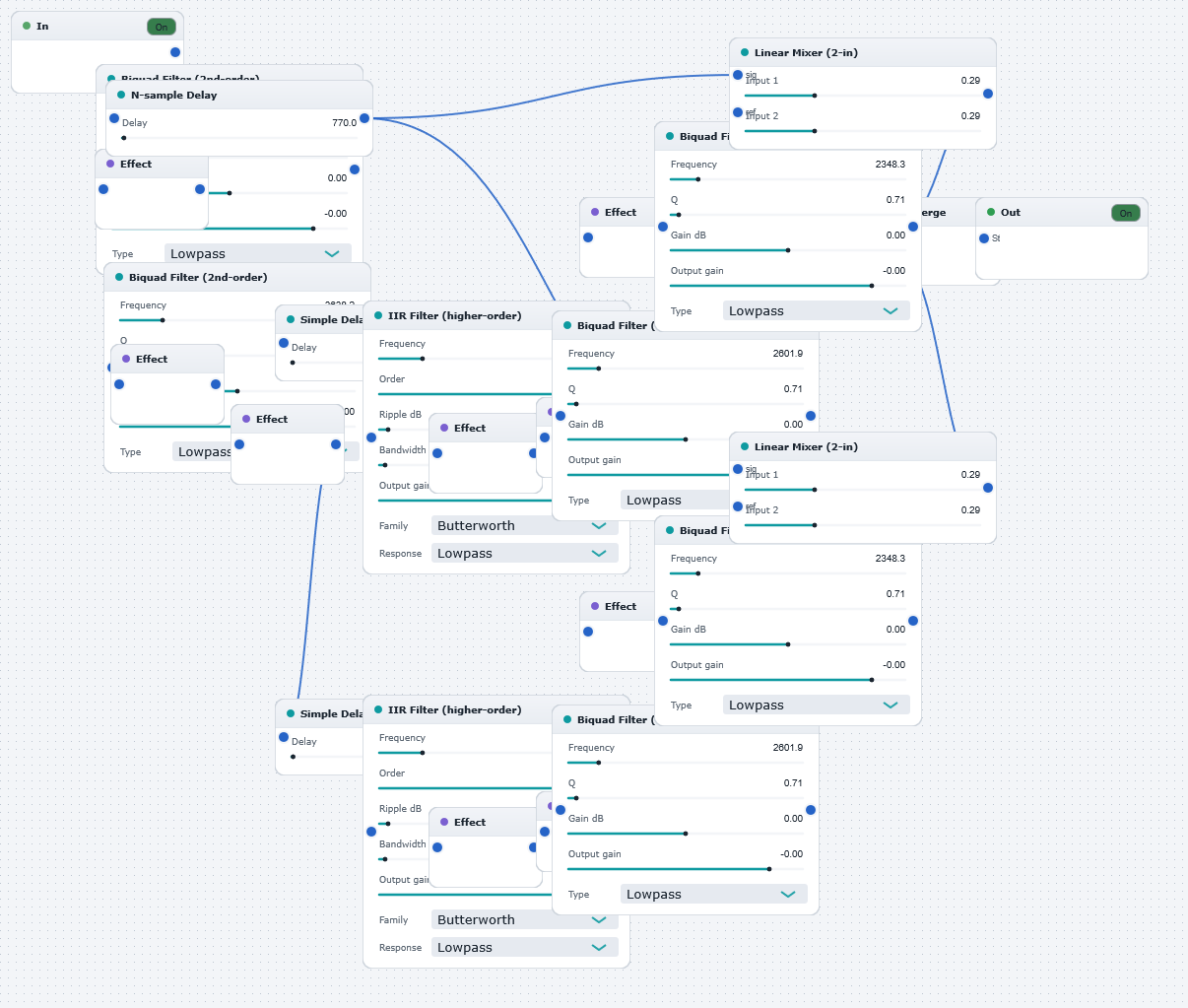
Another example of the use of multirate signal processing to achieve efficient filtering over wide frequency ranges. In this example, successive downsampling is used to reduce the sample rate by a factor of 16. Then, a delay followed by a low-pass IIR filter is used to shape the bass response before up-sampling again. This enables precise control of the bass response since the low-pass filter is running at 5kHz (instead of 44kHz) and the filter can be rather elaborate without excessive computational expense. Try experimenting with the parameters of the delay and the IIR low-pass block to appreciate the effect of different filter designs. By setting the delay of the left and right channels to be slightly different, the stereo field is enhanced. Try replacing the delay and IIR low-pass blocks with any other desired effect(s).
(Note: the 2-pole low-pass filters are used to further suppress aliasing/imaging before/after the down/up samplers)
(This board was built in WaveWarp 3.0, not in 1998, and it works the other way round from "MultirateBassBoostwithDelay" in this folder. It plays the audio file as MONO and MAKES a stereo image out of it: the downsampling half is shared - one pair of anti-alias filters and one set of downsamplers - and only after that does the signal split into two legs, each with its own delay, its own low-pass, its own upsamplers and its own anti-imaging filters, which are then combined into a stereo output. Because the two legs delay the same signal by different amounts (10 ms and 14 ms), you hear width where the input had none. The 1998 board does the opposite: it plays both channels of the file and runs one genuinely stereo chain over them, with a single stereo delay set to 15 ms on the left and 1 ms on the right.)