What it does
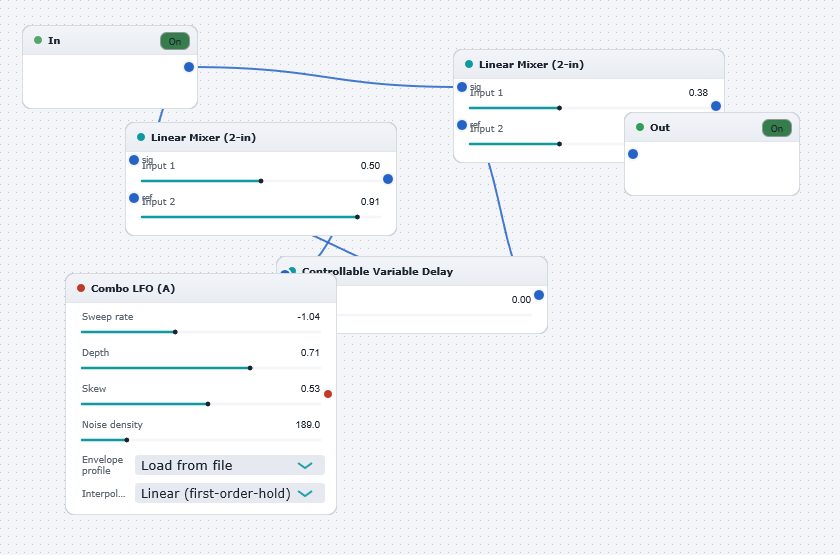
Feedback flanger built from basic elements.
The basic flanging effect is achieved by mixing the audio signal with a time-varying delayed version of itself. The effect can be enhanced by "feeding back" the output of the delay (combined with the audio input via a linear mixer) into its own input. The Controllable Variable Delay block implements the time-varying delay. This block has, in addition to the audio input, a control input (red) which is driven by a modulating control oscillator (the Combo Control Generator block).
Experiment with the control modulator and feedback gain settings to explore the behaviour of the flanger. Typically, a flanger will have delay lengths of 1--10 milliseconds, modulated by sinusoidal, triangular, or logarithmic envelopes. However, with feedback, the random and telegraphic noise modulators also lead to interesting results!