← All boards
Educational › Basic Principles

Quantization Noise Educational Example

Plays on the mobile app
The Quantization Noise Educational Example board in the WaveWarp DrawingBoard
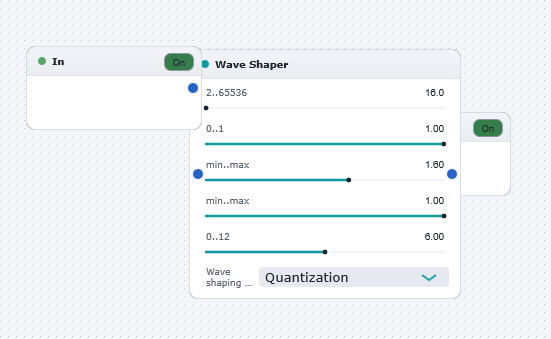
Quantization Noise Educational Example — the board as it opens in the WaveWarp DrawingBoard.

What it does

Quantization Noise Educational Example

Illustrates the use of the Wave Shaper block for quantizing the input audio signal. To appreciate the adverse effects of quantization, the quantizer is here set to 16 quantization steps which corresponds to 4 bits (i.e. 2-to-the-power-of-4 distinct amplitude levels to describe the signal). The noise introduced by this extreme level of quantization is readily apparent. Although quantization noise is a non-linear signal dependent phenomenon, it can be modelled as an additive zero-mean uniform stochastic process with an amplitude range from -Delta to +Delta where Delta=V/Number_of_Quantization_Steps and where V equals the signal amplitude (nominally V=1). With this simple model, it is straightforward to show that every additional bit in the quantization results in a 6dB improvement in signal-to-quantization-noise-ratio.

Try increasing the number of quantization steps to appreciate the corresponding improvement in audio quality. At 65536 steps (i.e. 16 bits) the effects of quantization are almost inaudible. The signal-to-quantization-noise-ratio is improved by 72dB compared with the 16-steps (i.e. 4 bits) case.

The in-built quantizing shaping function applies linear PCM coding to the signal. Try experimenting with different schemes by designing your own shaping functions (e.g. using MATLAB) and importing them into the Wave Shaper via the file I/O dialog box.

[Refs: (1) "The Computer Music Tutorial", Curtis Roads, The MIT Press, 1996. p 33. (2) "Advanced Signal Processing and Digital Noise Reduction", Saeed V. Vaseghi, Wiley-Teubner, 1996. p 20.]

Effects used

3 blocks 2 connections
In WaveWarp, 1998

How the original documented it

Quantization Noise Educational Example Illustrates the use of the Wave Shaper block for quantizing the input audio signal. To appreciate the adverse effects of quantization, the quantizer is here set to 16 quantization steps which corresponds to 4 bits (i.e. 2-to-the-power-of-4 distinct amplitude levels to describe the signal). The noise introduced by this extreme level of quantization is readily apparent. Although quantization noise is a non-linear signal dependent phenomenon, it can be modelled as an additive zero-mean uniform stochastic process with an amplitude range from -Delta to +Delta where Delta=V/Number_of_Quantization_Steps and where V equals the signal amplitude (nominally V=1). With this simple model, it is straightforward to show that every additional bit in the quantization results in a 6dB improvement in signal-to-quantization-noise-ratio. Try increasing the number of quantization steps to appreciate the corresponding improvement in audio quality. At 65536 steps (i.e. 16 bits) the effects of quantization are almost inaudible. The signal-to-quantization-noise-ratio is improved by 72dB compared with the 16-steps (i.e. 4 bits) case. The in-built quantizing shaping function applies linear PCM coding to the signal. Try experimenting with different schemes by designing your own shaping functions (e.g. using MATLAB) and importing them into the Wave Shaper via the file I/O dialog box. [Refs: (1) "The Computer Music Tutorial", Curtis Roads, The MIT Press, 1996. p 33. (2) "Advanced Signal Processing and Digital Noise Reduction", Saeed V. Vaseghi, Wiley-Teubner, 1996. p 20.]

Components used (1998)

Output Single-Mono WAVE DriverWave ShaperInput WAV file