← All boards
Audio Effects › Flangers

Cross Feedback Flanger

Plays on the mobile app
The Cross Feedback Flanger board in the WaveWarp DrawingBoard
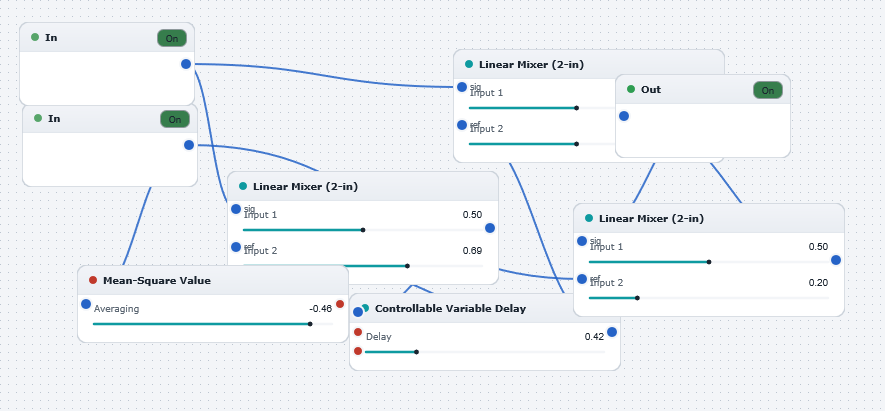
Cross Feedback Flanger — the board as it opens in the WaveWarp DrawingBoard.

What it does

Cross-feedback flanger built from basic elements.

This is a fun elaboration of the flanger effect whereby the the time-varying delay is controlled from the mean-square power of a second audio input signal, rather than from an oscillator (as in a conventional flanger).

The basic flanging effect is achieved by mixing the audio signal with a time-varying delayed version of itself. The effect can be enhanced by "feeding back" the output of the delay (combined with the audio input via a linear mixer) into its own input. The Controllable Variable Delay block implements the time-varying delay. This block has, in addition to the audio input, a control input (red) which is driven by the mean-square of the second audio input signal envelope (computed by the RMS block).

Effects used

8 blocks 10 connections
In WaveWarp, 1998

How the original documented it

Cross-feedback flanger built from basic elements. This is a fun elaboration of the flanger effect whereby the the time-varying delay is controlled from the mean-square power of a second audio input signal, rather than from an oscillator (as in a conventional flanger). The basic flanging effect is achieved by mixing the audio signal with a time-varying delayed version of itself. The effect can be enhanced by "feeding back" the output of the delay (combined with the audio input via a linear mixer) into its own input. The Controllable Variable Delay block implements the time-varying delay. This block has, in addition to the audio input, a control input (red) which is driven by the mean-square of the second audio input signal envelope (computed by the RMS block).

Components used (1998)

Controllable Variable DelayLinear MixerOutput Single-Mono WAVE DriverInput WAV fileLinear MixerMean-Square ValueInput WAV fileLinear Mixer