← All boards
Sound Synthesis

Chaotic Synthesis Example1

Plays on the mobile app
The Chaotic Synthesis Example1 board in the WaveWarp DrawingBoard
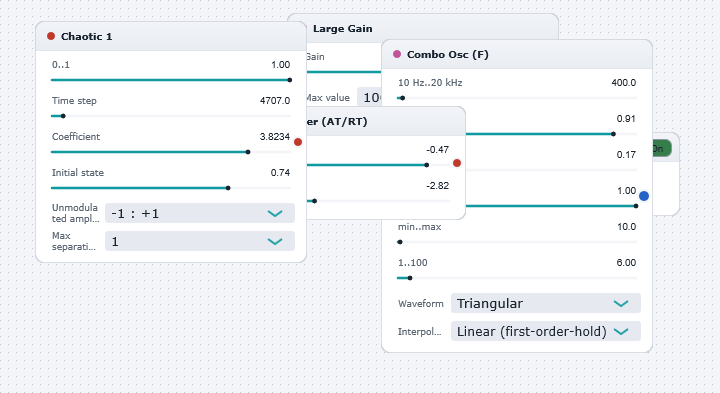
Chaotic Synthesis Example1 — the board as it opens in the WaveWarp DrawingBoard.

What it does

Chaotic Synthesis Example 1

Illustrates the use of the "Chaotic Control Generator 1" to create a frequency input signal for the Controllable Combo Oscillator. The result is a sequence of tones which follows the behaviour of the classic non-linear logistic equation at the core of the "Chaotic Control Generator 1" block. The "Control Smoother" is used to soften the tone transitions, and the "Large Control Gain" maps the control signal onto a desired frequency range for the oscillator.

Experiment with all settings of all blocks to explore the chaotic behaviour of the logistic equation and its interesting musical connotations!

[Refs: (1) "Introduction to Applied Mathematics", Gilbert Strang, Wellesley-Cambridge Press, 1986, p 505-510. (2) "Chaos: making a new science", James Gleick, Penguin Books, 1987, p 57-80. (3) "The Computer Music Tutorial", Curtis Roads, The MIT Press, 1996, p 888-889.]

Effects used

5 blocks 4 connections
In WaveWarp, 1998

How the original documented it

Chaotic Synthesis Example 1 Illustrates the use of the "Chaotic Control Generator 1" to create a frequency input signal for the Controllable Combo Oscillator. The result is a sequence of tones which follows the behaviour of the classic non-linear logistic equation at the core of the "Chaotic Control Generator 1" block. The "Control Smoother" is used to soften the tone transitions, and the "Large Control Gain" maps the control signal onto a desired frequency range for the oscillator. Experiment with all settings of all blocks to explore the chaotic behaviour of the logistic equation and its interesting musical connotations! [Refs: (1) "Introduction to Applied Mathematics", Gilbert Strang, Wellesley-Cambridge Press, 1986, p 505-510. (2) "Chaos: making a new science", James Gleick, Penguin Books, 1987, p 57-80. (3) "The Computer Music Tutorial", Curtis Roads, The MIT Press, 1996, p 888-889.]

Components used (1998)

Output Single-Mono WAVE DriverLarge Control GainControllable Combo Oscillator (F)Control Smoother with AT-RTChaotic Control Generator 1 (A)