What it does
Live Guitar Mellow Multirate Equalization
Demonstrates the use of WaveWarp's live input functionality, modular sample-by-sample architecture, digital filtering, and multirate audio engine. Plug an electric guitar (or any other audio source!) into the "input" of your soundcard and hit "Play". You will experience the rich mellow tones produced by the highly-selective multirate filtering.
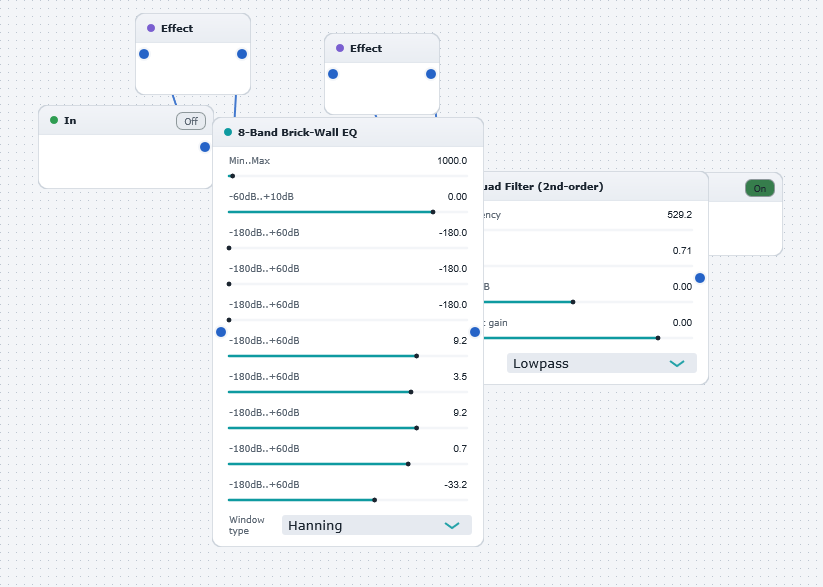
The input audio is downsampled by a factor of 9 before being filtered via the Brick-wall 8-band Equaliser. The use of downsampling means that the equaliser can be highly selective, as evidenced by the narrow frequency bands available in the equalizer parameter window. Note that the default settings are such that the mellow tones of the guitar have been boosted (via bands 4--6), and the higher bands have been attenuated (band 8). This high degree of frequency-band selectivity is only practically achievable because of WaveWarp's multriate capabilities. To achieve similar multiband selectivity in such a low frequency regime using standard filtering techniques at the base sample rate of 44.1 kHz would require a complicated filter which would be highly inefficient.
Also note that because of the rather low bandwidth of the guitar (i.e. limited to approximately 1 kHz) , it is sufficient to use rather simple down- and upsamplers for the factor of 9 resampling (assuming a base sample rate of 44.1 kHz). The simple IIR 2-pole low-pass filter after the upsampler is used to attenuate the slight "rattling" due to imaging distortion caused by the use of the simple First-order-hold UpSampler (rather than a more elaborate upsampler with a built-in anti-imaging filter).
Experiment with all settings and with different input sources! Try alternative filtering methods and different resampling factors.