What it does
Live Guitar Sympathetic Strings, Sustain
The same six string resonators as Live Guitar Sympathetic Strings, but each loop loses far less energy per pass, so the strings ring for minutes rather than seconds: by the loop-gain formula about 40 s at the top E, rising past two and a half minutes at the bottom E. A whole bank decays as a mixture of six different lengths, so what you hear runs somewhat shorter than the per-string figure. Play a chord and it hangs in the air behind you; play against it and the strings that match what you are playing answer while the others stay quiet.
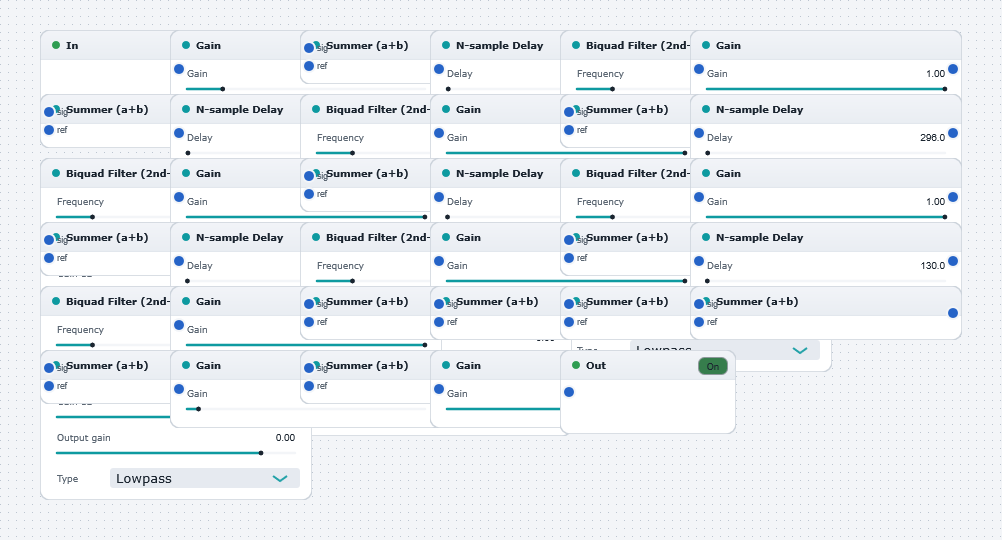
HOW IT IS BUILT. Six independent loops, one per open string (E A D G B E). Each is a summer feeding a delay line whose length sets the pitch, then a lowpass inside the loop so the high harmonics die away faster than the fundamental as they do on a real string, then a gain just under one that returns the signal to its own summer. The six are added together only at the output: that sum is never fed back anywhere, so the strings cannot gang up into a howl and nothing here self-oscillates. Every loop gain is below unity, so the board is silent until you play and always decays.
WHAT TO REACH FOR. String coupling sets how hard your playing drives the strings. Each string's own Gain sets how long that string rings -- they are equal here, which means the LOW strings ring longest, as on a real guitar, rather than every string ringing for the same time. Raising a Gain towards 1.0 lengthens the ring steeply; going to or past 1.0 would turn the string into an oscillator that never stops, which is not what this board is for. The Lowpass Frequency inside each loop sets how bright the ring stays -- lower it for a darker, more distant halo. Note the delay lengths compensate for that filter's own delay, so a large change to Lowpass Frequency will pull the strings slightly out of tune.
And the delay lengths are counted in SAMPLES, so the tuning above is right at 44.1 kHz and shifts with the device rate -- every string goes about +147 cents sharp at 48 kHz -- until the lengths are derived from the sample rate at load time.