What it does
Live Guitar Sympathetic Strings (Lush)
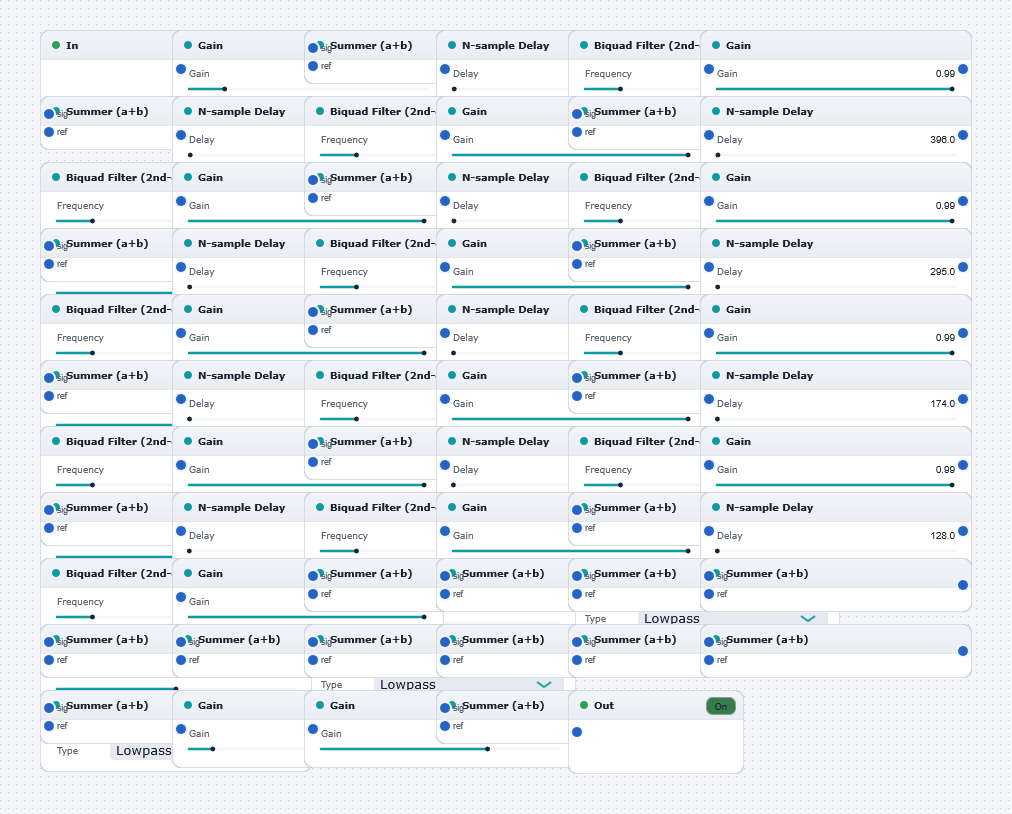
Twelve string resonators that ring in sympathy with your playing -- the six strings of the plainer Sympathetic Strings board, each doubled by a second resonator tuned a few cents away from it. Two strings at almost the same pitch drift slowly in and out of phase with one another, so a ring swells and fades instead of simply decaying. That slow beating is the whole point of this version, and it is the same thing that makes a twelve-string guitar sound wider than a six.
Plug a guitar (or anything else) into your soundcard input, enable the input block, and play. Each resonator responds only to energy near its own pitch, so what rings depends on what you play rather than being added evenly across everything. Nothing here generates sound: a resonator is silent until something excites it, so the strings are driven entirely by your own signal.
The pairs are one sample apart in delay length, which is the finest detuning the delay lines allow. That works out at about three cents on the low E and about thirteen on the top E, so the beating is slow and subtle low down and faster and more obvious up high.
Every string here is given the SAME per-pass gain, which is the other difference from the plainer board. Equal gain means the low strings ring longest -- roughly six seconds on the low E falling to under two on the top E -- the way a real guitar behaves. The plainer board holds the ring time equal instead, which makes its upper strings dominate.
Controls: String coupling how hard the strings are driven; raise it for a more pronounced ring. Gain (per string) that string's ring time. Close to 1 rings for a long time; at 1 it never decays. Wet how much of the ringing strings you hear against the direct signal. Lowpass Frequency (per string) how bright that string's ring stays.
Three things worth knowing if you edit it. The delay lengths are set slightly SHORT of each string's nominal period, because the lowpass inside each loop contributes delay of its own -- so changing a Lowpass Frequency detunes that string a little, and its delay wants trimming to match. And the two halves of a pair must keep their one-sample difference: set them to the same length and the beating disappears, which is the effect this board exists for. And the delay lengths are counted in SAMPLES, so the tuning above is right at 44.1 kHz and shifts with the device rate -- every string goes about +147 cents sharp at 48 kHz -- until the lengths are derived from the sample rate at load time.
Try raising the Wet control well past its default for a wash that keeps answering after you stop playing, or pulling one pair's Gain down to thin out the register it covers.