What it does
Live Guitar Sympathetic Strings
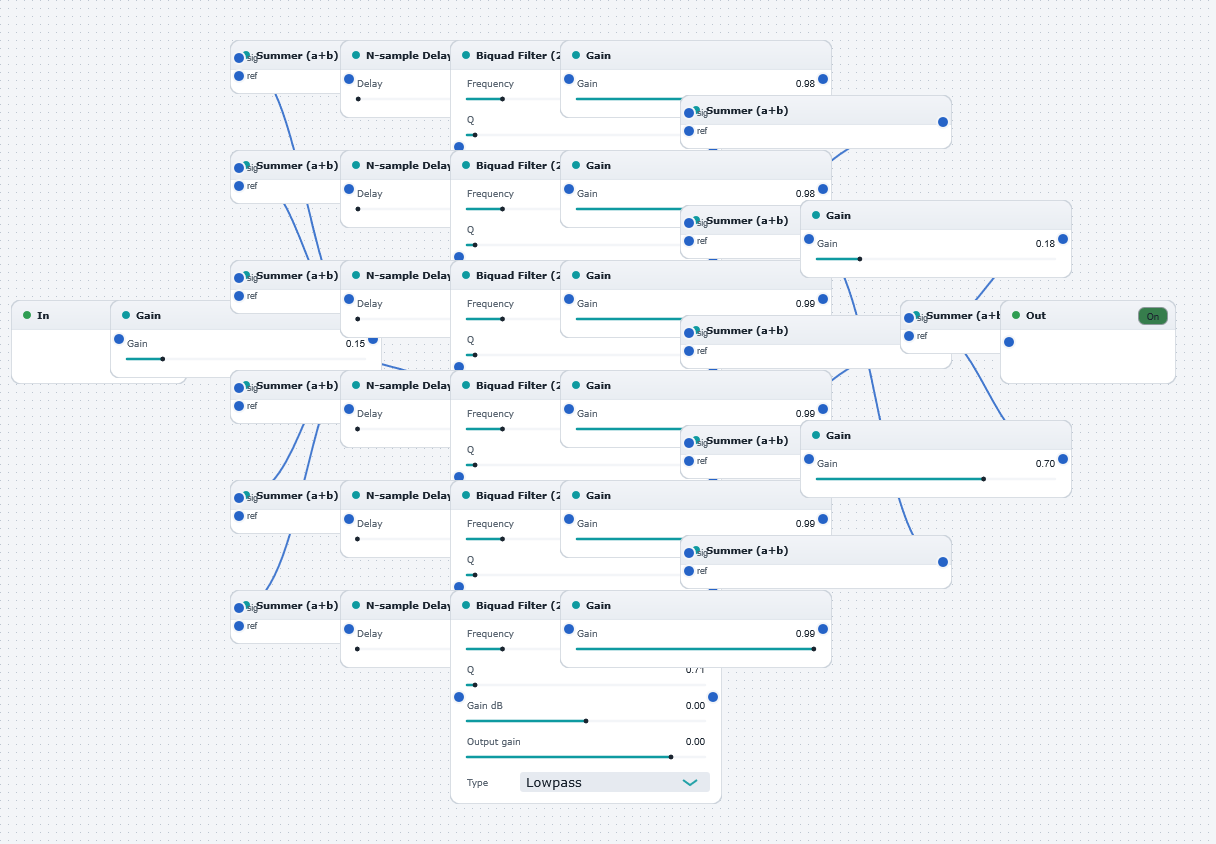
Six string resonators that ring in sympathy with your playing, the way the strings you are not playing answer a struck note on a real guitar. Plug a guitar (or anything else) into your soundcard input, enable the input block, and play. Each resonator responds only to energy near its own pitch, so what rings depends on what you play rather than being added evenly across everything.
Each string is a delay line whose length sets its pitch -- E2, A2, D3, G3, B3 and E4 -- with a lowpass filter inside its feedback loop, so the upper harmonics of a ring fade before the fundamental does. That is what a real string does, and it is why this sounds plucked rather than filtered. Nothing in this board generates sound: a resonator is silent until something excites it, so the strings are driven entirely by your own signal.
Controls: String coupling how hard the strings are driven; raise it for a more pronounced ring. Gain (per string) that string's ring time. Close to 1 rings for a long time; at 1 it never decays. Wet how much of the ringing strings you hear against the direct signal. Lowpass Frequency (per string) how bright that string's ring stays.
Three things worth knowing if you edit it. The delay lengths are set slightly SHORT of each string's nominal period, because the lowpass inside each loop contributes delay of its own -- so changing a Lowpass Frequency detunes that string a little, and its delay wants trimming to match. And the upper strings resonate more strongly than the lower ones, because a shorter loop needs a higher per-pass gain to ring for the same length of time; lower their Gain if you prefer an even balance. And the delay lengths are counted in SAMPLES, so the tuning above is right at 44.1 kHz and shifts with the device rate -- every string goes about +147 cents sharp at 48 kHz -- until the lengths are derived from the sample rate at load time.
Try raising one string's Gain towards 1 and leaving the others low, for a single note that answers only when you play near it.