← All boards
Educational › Effects Built From Scratch

Sine Wave Panner Built From Scratch_2

Plays on the mobile app
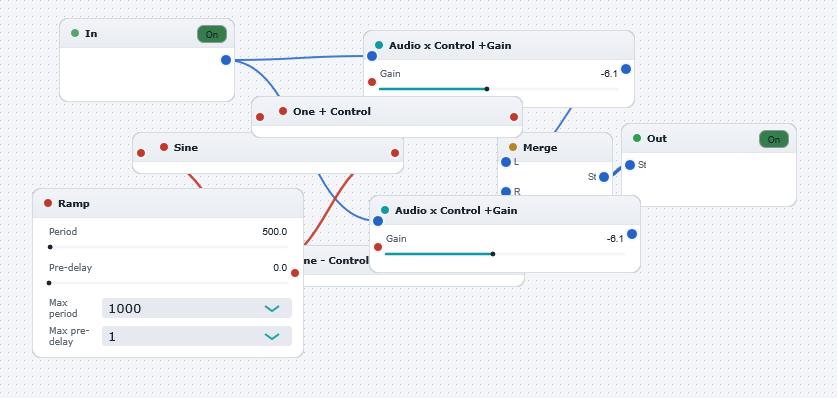
The Sine Wave Panner Built From Scratch_2 board in the WaveWarp DrawingBoard
Sine Wave Panner Built From Scratch_2 — the board as it opens in the WaveWarp DrawingBoard.

What it does

Sinewave panner built from scratch

Illustrates how to build a stereo sinewave auto-panner by multiplying a mono audio signal by separate "left" and "right" amplitude modulation signals which are then "zipped up" to form a stereo output. The Ramp Control Generator is used to generate a ramp signal which rises from 0 to 2*pi over a user-selectable duration. This ramp signal represents the (wrapped) phase of an oscillator. The Control Sine block calculates the trigonometric sine of the ramp signal. The One plus Control and One minus Control blocks are used to distribute the signals to the "left" and "right" channels respectively. This is only one example of how to distibute the signal between the channels. Other variations on the theme are, of course, entirely possible.

Likewise, the structure can easily be extended to generate multi-channel panners instead of merely stereo (i.e. 2 channels).

Effects used

9 blocks 10 connections
In WaveWarp, 1998

How the original documented it

Sinewave panner built from scratch Illustrates how to build a stereo sinewave auto-panner by multiplying a mono audio signal by separate "left" and "right" amplitude modulation signals which are then "zipped up" to form a stereo output. The Ramp Control Generator is used to generate a ramp signal which rises from 0 to 2*pi over a user-selectable duration. This ramp signal represents the (wrapped) phase of an oscillator. The Control Sine block calculates the trigonometric sine of the ramp signal. The One plus Control and One minus Control blocks are used to distribute the signals to the "left" and "right" channels respectively. This is only one example of how to distibute the signal between the channels. Other variations on the theme are, of course, entirely possible. Likewise, the structure can easily be extended to generate multi-channel panners instead of merely stereo (i.e. 2 channels).

Components used (1998)

Control SineInput WAV fileOne minus ControlZipperOutput Stereo WAVE DriverMultiply Audio by Control with GainMultiply Audio by Control with GainOne plus ControlRamp Control Generator