What it does
Simple FIR high-pass filter built from scratch
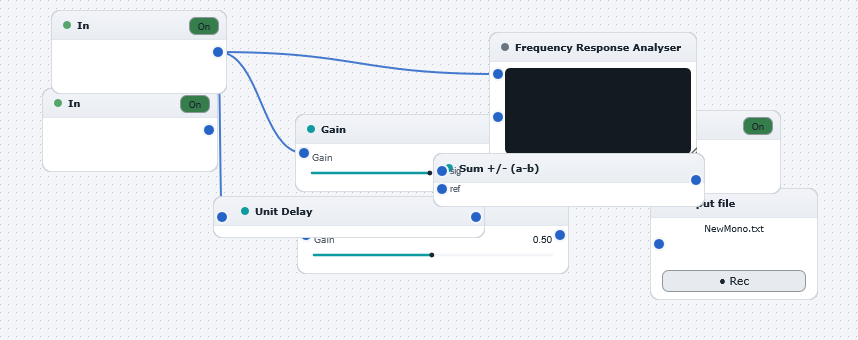
Illustrates how to build a simple high-pass filter from a single delay (Unit Delay) and two gains (Simple gains). The output of the filter is a weighted difference of the current input and the previous input. This filter is known as a "Finite Impulse Response" (FIR) filter since the output depends only on the weighted sequence of inputs (by contrast, an "Infinite Impulse Response" (IIR) filter utilises the previous outputs as well as the inputs). Play the DrawingBoard and observe the characteristic high-pass response displayed in the magnitude plot. Adjust the gain values and note how they determine the frequency response characteristics of the filter.
For a detailed discussion on this basic filter, see: "The Computer Music Tutorial", Curtis Roads, The MIT Press, 1996 (p.404-405), and "Wavelets and Filter Banks", Gilbert Strang and Truong Nguyen, Wellesley-Cambridge Press, 1996 (p. 12-13).
Delays and gains are the elemental buliding blocks of all filters. Try building more elaborate filters from these basic blocks. Note that ASCII input and output files (included but unconnected in this DrawingBoard) are very useful when prototyping a filter design since they allow direct access to the exact input/output numerical data, without the scaling inherent to WAV I/O conversions.