← All boards
Educational › Basic Principles

Psychoacoustics Educational Example2

Plays on the mobile app
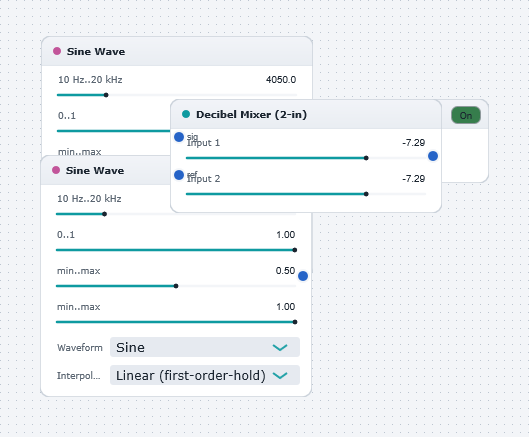
The Psychoacoustics Educational Example2 board in the WaveWarp DrawingBoard
Psychoacoustics Educational Example2 — the board as it opens in the WaveWarp DrawingBoard.

What it does

PsychoacousticsEducationalExample2

Simple DrawingBoard for illustrating psychoacoustical phenomena associated with the perceived pitch and loudness of two tones with a given frequency separation, played simultaneously.

Play the DrawingBoard with the Signal Generators set to their default values of 4000 Hz and 4050 Hz, respectively. You will perceive a combined "shrill" composite tone, of a certain loudness. Now change the frequency of the first Signal Generator from 4000 Hz to 3000 Hz without changing the amplitude or the volume setting of your soundcard or external amplifier. You will now perceive two separate "pure" tones, and the overall loudness will seem greater than before. In the former case, i.e. with frequencies of 4000 Hz and 4050 Hz, the difference between the frequencies is less than (approximately) 20% which means that they lie within the same "critical band", and the psychoacoustical phenomenon of "masking" occurs. The total perceived loudness of tones within the same critical band is significantly less than the total perceived loudness when they are in separate critical bands (as in the latter case with frequencies of 3000 Hz and 4050 Hz, respectively). In other words, when they are in the same critical band, one tone "masks" the other. (It is for this reason that two violins playing the same note don't seem twice as loud as a single violin, yet a single violin playing a solo is clearly audible against a background of violins in the string section).

The perceived "shrillness" in pitch is another well-known psychoacoustical phenomenon when tones lie within the same critical band. Only when they lie within different critical bands, can they be perceived as separately identifiable tones. As a final experiment, adjust the first frequency to 4049 Hz (keeping the second at 4050 Hz). The perceived pitch will now exhibit noticeable "beats" at the frequency equal to the difference in the underlying frequencies, i.e. 1 Hz in this example. This is another well-known effect for closely-spaced frequencies. As the frequency separation increases, the beats give way to shrillness, and then ultimately to separate tones (when the separation is great enough that each tone lies in a separate critical band).

Note that in these experiments, the underlying frequencies have been chosen in the vicinity of 4000 Hz in order to maximise the perceived loudness (of each individual tone) with regard to the Fletcher-Munson curves which relate the frequency-dependent perceived loudness to the physical intensity (for a single tone). In other words, the loudness attenuation observed in the two-tone experiments can be attributed primarily to "masking" and not to the Fletcher-Munson curves (see "PsychoacousticsEducationalExample1.dwb" for a demonstration of the Fletcher-Munson curves).

[Ref: F Richard Moore, Elements of Computer Music, P T R Prentice Hall, 1990 (p. 215-216)].

Effects used

4 blocks 3 connections
In WaveWarp, 1998

How the original documented it

PsychoacousticsEducationalExample2 Simple DrawingBoard for illustrating psychoacoustical phenomena associated with the perceived pitch and loudness of two tones with a given frequency separation, played simultaneously. Play the DrawingBoard with the Signal Generators set to their default values of 4000 Hz and 4050 Hz, respectively. You will perceive a combined "shrill" composite tone, of a certain loudness. Now change the frequency of the first Signal Generator from 4000 Hz to 3000 Hz without changing the amplitude or the volume setting of your soundcard or external amplifier. You will now perceive two separate "pure" tones, and the overall loudness will seem greater than before. In the former case, i.e. with frequencies of 4000 Hz and 4050 Hz, the difference between the frequencies is less than (approximately) 20% which means that they lie within the same "critical band", and the psychoacoustical phenomenon of "masking" occurs. The total perceived loudness of tones within the same critical band is significantly less than the total perceived loudness when they are in separate critical bands (as in the latter case with frequencies of 3000 Hz and 4050 Hz, respectively). In other words, when they are in the same critical band, one tone "masks" the other. (It is for this reason that two violins playing the same note don't seem twice as loud as a single violin, yet a single violin playing a solo is clearly audible against a background of violins in the string section). The perceived "shrillness" in pitch is another well-known psychoacoustical phenomenon when tones lie within the same critical band. Only when they lie within different critical bands, can they be perceived as separately identifiable tones. As a final experiment, adjust the first frequency to 4049 Hz (keeping the second at 4050 Hz). The perceived pitch will now exhibit noticeable "beats" at the frequency equal to the difference in the underlying frequencies, i.e. 1 Hz in this example. This is another well-known effect for closely-spaced frequencies. As the frequency separation increases, the beats give way to shrillness, and then ultimately to separate tones (when the separation is great enough that each tone lies in a separate critical band). Note that in these experiments, the underlying frequencies have been chosen in the vicinity of 4000 Hz in order to maximise the perceived loudness (of each individual tone) with regard to the Fletcher-Munson curves which relate the frequency-dependent perceived loudness to the physical intensity (for a single tone). In other words, the loudness attenuation observed in the two-tone experiments can be attributed primarily to "masking" and not to the Fletcher-Munson curves (see "PsychoacousticsEducationalExample1.dwb" for a demonstration of the Fletcher-Munson curves). [Ref: F Richard Moore, Elements of Computer Music, P T R Prentice Hall, 1990 (p. 215-216)].

Components used (1998)

Sine Wave GeneratorOutput Single-Mono WAVE DriverSine Wave GeneratorDecibel Mixer