What it does
Polyphase versus direct implementation of a downsampler: direct case
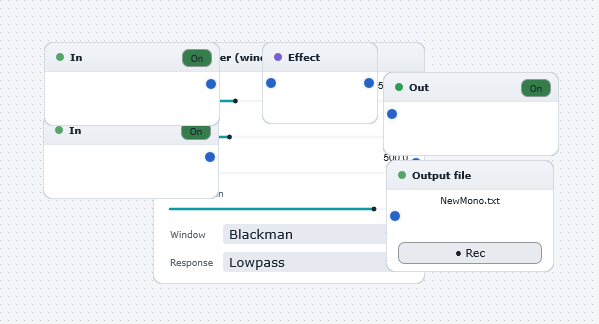
Demonstrates how to build an anti-aliasing downsampler in the "direct" (straightforward) implementation. In this example, the sample rate is reduced by a factor of 4 (via the Simple DownSampler). An FIR anti-aliasing low-pass filter is included before the downsampler, in order to suppress aliasing. The filter is imported from an off-line design (created using the MATLAB code in the script-file "wwxmpl12.m" located in the wwmatlab directory). Observe that the frequency response of the filter has a cut-off frequency at a fourth of the Nyquist frequency, as required for a 4-factor downsampler.
Play the DrawingBoard and note that the audio sounds reasonable, despite the significant degree of downsampling. The "high frequencies" have, however, been attenuated as expected from the low-pass filtering (compare with the original by temporarily bypassing the entire downsampling chain to appreciate the difference).
An important point about this direct implementation, i.e. with the anti-alias filtering performed before the downsampling, is that the filter is executed at the high sample rate. This is wasteful bearing in mind that the 4-factor downsampler "throws away" 3 out of 4 samples! There is, in fact, a considerably more efficient implementation which gives identical results. It is known as the polyphase implementation, and is demonstrated in the companion ExampleDrawingBoard "PolyphaseVersusDirectDownsamplingEducationalExample2.dwb" .
For a thorough discussion on polyphase filtering, see "Wavelets and Filter Banks" by Gilbert Strang and Truong Nguyen, Wellesley-Cambridge Press, 1996, and "Multirate Digital Signal Processing" by Ronald E Crochiere and Lawrence R Rabiner, Prentice Hall, 1983.
This DrawingBoard nicely illustrates the power and versatility of WaveWarp's sample-by-sample multirate audio engine.
(WaveWarp 3.0, node 1: this "FIR low-pass" loaded 139 coefficients from an off-line design file ("dec4.txt") that this version cannot reproduce tap for tap. It runs an equivalent filter instead - a 139-tap Blackman-windowed low-pass at the same 5510 Hz cutoff, matching the original's passband and its 6 dB point; an octave above the cutoff it is 111 dB down, where the 1998 filter was 66 dB down.)