← All boards
Educational › Basic Principles

Convolution Educational Example2

Plays on the mobile app
The Convolution Educational Example2 board in the WaveWarp DrawingBoard
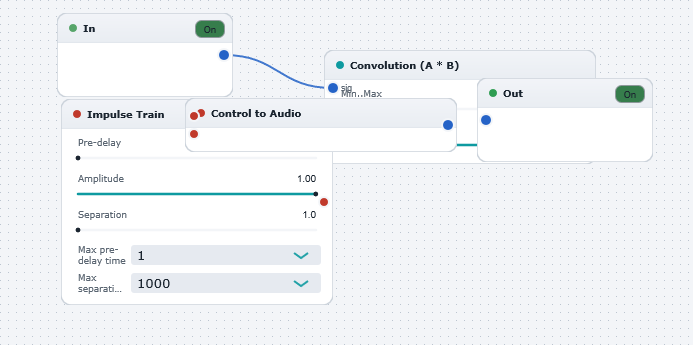
Convolution Educational Example2 — the board as it opens in the WaveWarp DrawingBoard.

What it does

Convolution Educational Example 2

Illustrates an important axiom of convolution: namely that the convolution of any signal with the unit impulse preserves the original signal exactly.

The "Convolution" block is used to calculate the exact convolution of an audio signal with a stream of impluses. The distance between the impulses is, in this case, set to the default "separation" of 1000 samples. This means that an impulse occurs every 1001 samples. By ensuring that the convolutuion length is set to the same value, i.e. 1001 samples, then the ouput of the convolution is exactly the same as the original signal, though delayed by the length of the convolutuion (1001 samples).

Notes: The Convolution block performs pure convolution of the two inputs. Although it uses the Fast Fourier Transform (FFT) for efficiency, appropriate zero-padding and overlapping is applied to eliminate "circular convolution", such that the output is exactly the direct convolution of the two inputs, as if the computations were carried out in the time domain. The only tell-tale sign that the FFT has been used is the inherent "latency". In other words, the output is delayed by the length of the input data buffer.

Effects used

5 blocks 4 connections
In WaveWarp, 1998

How the original documented it

Convolution Educational Example 2 Illustrates an important axiom of convolution: namely that the convolution of any signal with the unit impulse preserves the original signal exactly. The "Convolution" block is used to calculate the exact convolution of an audio signal with a stream of impluses. The distance between the impulses is, in this case, set to the default "separation" of 1000 samples. This means that an impulse occurs every 1001 samples. By ensuring that the convolutuion length is set to the same value, i.e. 1001 samples, then the ouput of the convolution is exactly the same as the original signal, though delayed by the length of the convolutuion (1001 samples). Notes: The Convolution block performs pure convolution of the two inputs. Although it uses the Fast Fourier Transform (FFT) for efficiency, appropriate zero-padding and overlapping is applied to eliminate "circular convolution", such that the output is exactly the direct convolution of the two inputs, as if the computations were carried out in the time domain. The only tell-tale sign that the FFT has been used is the inherent "latency". In other words, the output is delayed by the length of the input data buffer.

Components used (1998)

ConvolutionInput WAV fileImpulse Train Control Generator (A)Control to AudioOutput Single-Mono WAVE Driver