← All boards
Audio Effects › Spectral Transformations

Dancing Money Convolution Vocoder

Plays on the mobile app
The Dancing Money Convolution Vocoder board in the WaveWarp DrawingBoard
Dancing Money Convolution Vocoder — the board as it opens in the WaveWarp DrawingBoard.

What it does

Dancing Money Vocoder!

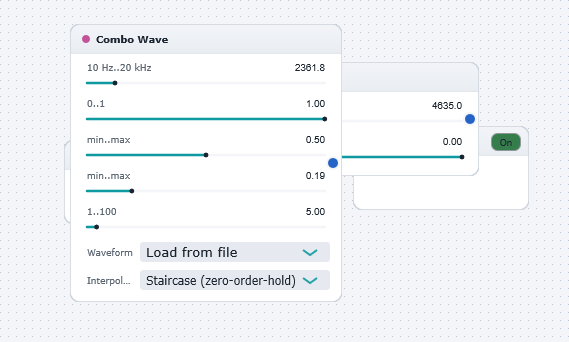
Illustrates the technique of spectral cross-synthesis based on convolution of two signals. The signals can be of any origin. In this case, a sequence of financial data is convolved with a dance track. The financial data (stored in the ascii wavetable file "finance.txt") corresponds to the percentage daily price variation of oats (on the US commodities market) from March 1979 to November 1995.

The financial data is convolved with a dance track ("dance.wav"), thus imposing the underlying spectral characteristics of the dance music on to the price fluctuations..

Try varying the parameters of all components to investigate the behaviour of the vocoder. Experiment with different audio signals and driving signals (e.g. other financial time series !)

The Convolution block performs pure convolution of the two inputs. Although it uses the Fast Fourier Transform (FFT) for efficiency, appropriate zero-padding and overlapping is applied to eliminate "circular convolution", such that the output is exactly the direct convolution of the two inputs, as if the computations were carried out in the time domain. The only tell-tale sign that the FFT has been used is the inherent "latency". In other words, the output is delayed by the length of the input data buffer.

Effects used

4 blocks 3 connections
In WaveWarp, 1998

How the original documented it

Dancing Money Vocoder! Illustrates the technique of spectral cross-synthesis based on convolution of two signals. The signals can be of any origin. In this case, a sequence of financial data is convolved with a dance track. The financial data (stored in the ascii wavetable file "finance.txt") corresponds to the percentage daily price variation of oats (on the US commodities market) from March 1979 to November 1995. The financial data is convolved with a dance track ("dance.wav"), thus imposing the underlying spectral characteristics of the dance music on to the price fluctuations.. Try varying the parameters of all components to investigate the behaviour of the vocoder. Experiment with different audio signals and driving signals (e.g. other financial time series !) The Convolution block performs pure convolution of the two inputs. Although it uses the Fast Fourier Transform (FFT) for efficiency, appropriate zero-padding and overlapping is applied to eliminate "circular convolution", such that the output is exactly the direct convolution of the two inputs, as if the computations were carried out in the time domain. The only tell-tale sign that the FFT has been used is the inherent "latency". In other words, the output is delayed by the length of the input data buffer.

Components used (1998)

Input WAV fileOutput Single-Mono WAVE DriverConvolutionCombo Wave Generator