← All boards
Audio Effects › Dynamic Range Control

Noise Gate Built From Scratch

Plays on the mobile app
The Noise Gate Built From Scratch board in the WaveWarp DrawingBoard
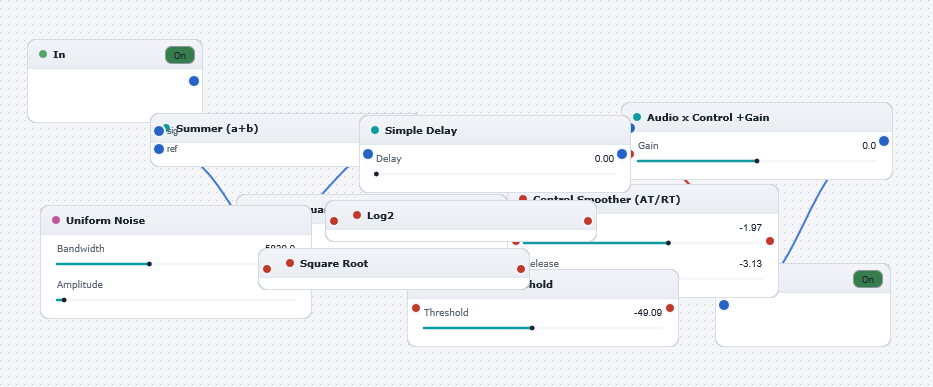
Noise Gate Built From Scratch — the board as it opens in the WaveWarp DrawingBoard.

What it does

Audio noise gate built from basic elements.

A measurement of mean-square audio amplitude is used to generate a gain-reduction control signal (in red) which is multiplied by the input, eliminating the output amplitude below the user-defined threshold. The logarithm block is required to convert the mean-square measurement to dB. The control noise gate block compares the measured mean-square value (in dB) with the user-defined dB threshold (slider in the Noise-Gate Threshold block), and generates a gain-reduction signal of a "infinite ratio" (zero gain) if the mean-square value is below the threshold. This signal is then smoothed and multiplied by a delayed version of the input audio signal, thus limiting the amplitude of the output audio signal. The gain smoother has a hysteresis loop to determine whether the noise-gate is in the attack or release phase. The delay gives the system a predictive ("look-ahead") capability. Experiment with the settings of all blocks to explore the behaviour of the noise gate.

Effects used

11 blocks 11 connections
In WaveWarp, 1998

How the original documented it

Audio noise gate built from basic elements. A measurement of mean-square audio amplitude is used to generate a gain-reduction control signal (in red) which is multiplied by the input, eliminating the output amplitude below the user-defined threshold. The logarithm block is required to convert the mean-square measurement to dB. The control noise gate block compares the measured mean-square value (in dB) with the user-defined dB threshold (slider in the Noise-Gate Threshold block), and generates a gain-reduction signal of a "infinite ratio" (zero gain) if the mean-square value is below the threshold. This signal is then smoothed and multiplied by a delayed version of the input audio signal, thus limiting the amplitude of the output audio signal. The gain smoother has a hysteresis loop to determine whether the noise-gate is in the attack or release phase. The delay gives the system a predictive ("look-ahead") capability. Experiment with the settings of all blocks to explore the behaviour of the noise gate.

Components used (1998)

Output Single-Mono WAVE DriverInput WAV fileMean-Square ValueControl Smoother with AT-RTMultiply Audio by Control with GainSimple SummerControl Log2Simple delayNoise-Gate ThresholdRandom Uniform Noise Generator